REF: MEN-2026-0077
Radiology
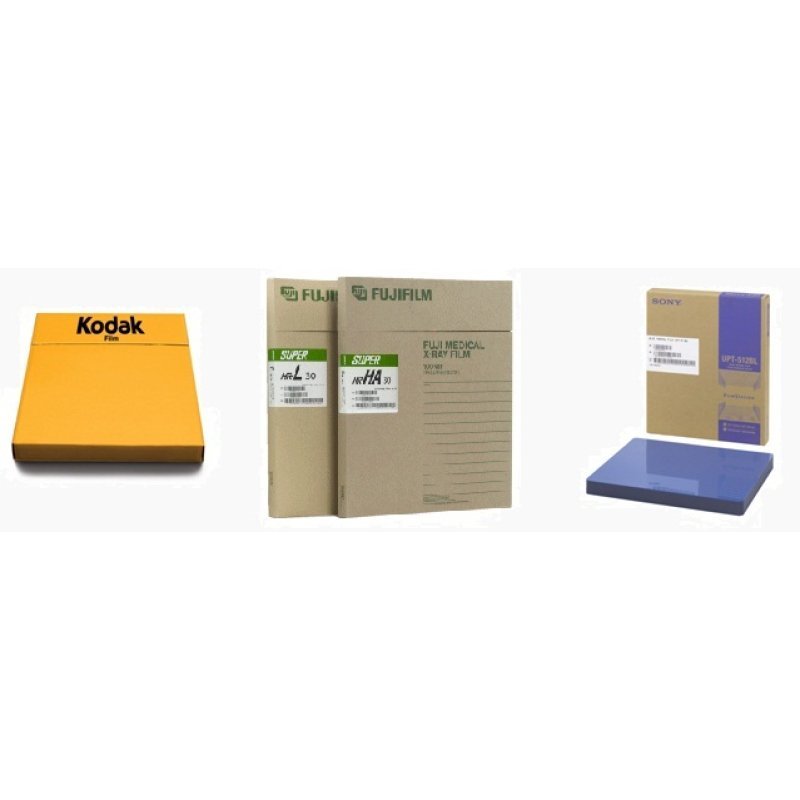
X-ray Film
Sold & Shipped By
Official Store
Price on Request
Product Code MEN-2026-0077
Condition New
Availability In Stock
Warranty
Sub-Category X-ray
Composition: Films are generally composed of a protective super coat, an emulsion layer (containing radiation-sensitive silver halide crystals, such as silver bromide and silver iodide), an adhesive layer, and a durable polyester base.
Emulsion Types: Films can be single-emulsion (one side, for higher detail) or double-emulsion (both sides, for higher speed/lower dose).
Speed/Sensitivity: This refers to the emulsion's ability to respond to radiation. Fast films (larger crystals) require less exposure but produce more graininess, while slow films (smaller crystals) offer higher image detail.
Contrast: High-contrast films produce a black-and-white image, whereas low-contrast films show more shades of gray.
Spectral Sensitivity: Films are designed to match the light emission of intensifying screens, commonly blue-sensitive or green-sensitive (orthochromatic).
Latent Image Formation: When exposed, the silver halide crystals form a "latent image" (hidden image) that is chemically converted into a visible, permanent image during processing.
Physical Characteristics: Films are flexible, strong, and dimensionally stable to maintain shape during
processing and storage.
Emulsion Types: Films can be single-emulsion (one side, for higher detail) or double-emulsion (both sides, for higher speed/lower dose).
Speed/Sensitivity: This refers to the emulsion's ability to respond to radiation. Fast films (larger crystals) require less exposure but produce more graininess, while slow films (smaller crystals) offer higher image detail.
Contrast: High-contrast films produce a black-and-white image, whereas low-contrast films show more shades of gray.
Spectral Sensitivity: Films are designed to match the light emission of intensifying screens, commonly blue-sensitive or green-sensitive (orthochromatic).
Latent Image Formation: When exposed, the silver halide crystals form a "latent image" (hidden image) that is chemically converted into a visible, permanent image during processing.
Physical Characteristics: Films are flexible, strong, and dimensionally stable to maintain shape during
processing and storage.
Base: Typically a 150 to 300
m thick, transparent, flexible, and durable polyester sheet.
Emulsion: The sensitive layer, containing silver halide crystals (silver bromide/iodide) suspended in gelatin.
Double-Emulsion (Screen Film): Coated on both sides for higher speed (reduced patient dose).
Single-Emulsion: Coated on one side; used for high-detail, max-resolution applications like mammography.
Super coat: A thin, protective, anti-abrasive gelatin layer covering the emulsion.
Anti-Halation/Anti-Crossover Layer: Included to reduce light reflection and crossover, which improves sharpness.
Film Speed (Sensitivity): Defines the film's sensitivity to radiation. Faster films require lower exposure but produce more image noise (graininess).
Contrast (Gamma): Represents the difference in density between adjacent areas. High-contrast film produces distinct black-and-white images (good for bone), while low-contrast film offers more gray shades.
Exposure Latitude: The range of exposures that produce a usable image. High contrast usually means low latitude (less forgiving).
Spatial Resolution (Detail): Ability to show fine details. Finer grains produce higher resolution but require higher exposure.
Optical Density (Density): The measure of blackness, ranging from 0 to 4 in industrial applications.
Blue-Sensitive: Sensitive to the blue light emitted by calcium tungstate screens.
Orthochromatic (Green-Sensitive): Sensitive to green light from rare-earth screens, reducing patient dose due to higher efficiency.
Non-Screen Film: Designed for direct X-ray exposure without intensifying screens; features a thicker emulsion for high-detail applications like dental radiography.
14 x 17 inches (35 x 43 cm): The standard large format for chest, abdomen, and skeletal surveys.
8 x 10 inches and 10 x 12 inches: Common for smaller anatomical areas.
Industrial Rolls/Sheets: Available in various lengths and widths, sometimes pre-packaged with lead screen
m thick, transparent, flexible, and durable polyester sheet.
Emulsion: The sensitive layer, containing silver halide crystals (silver bromide/iodide) suspended in gelatin.
Double-Emulsion (Screen Film): Coated on both sides for higher speed (reduced patient dose).
Single-Emulsion: Coated on one side; used for high-detail, max-resolution applications like mammography.
Super coat: A thin, protective, anti-abrasive gelatin layer covering the emulsion.
Anti-Halation/Anti-Crossover Layer: Included to reduce light reflection and crossover, which improves sharpness.
Film Speed (Sensitivity): Defines the film's sensitivity to radiation. Faster films require lower exposure but produce more image noise (graininess).
Contrast (Gamma): Represents the difference in density between adjacent areas. High-contrast film produces distinct black-and-white images (good for bone), while low-contrast film offers more gray shades.
Exposure Latitude: The range of exposures that produce a usable image. High contrast usually means low latitude (less forgiving).
Spatial Resolution (Detail): Ability to show fine details. Finer grains produce higher resolution but require higher exposure.
Optical Density (Density): The measure of blackness, ranging from 0 to 4 in industrial applications.
Blue-Sensitive: Sensitive to the blue light emitted by calcium tungstate screens.
Orthochromatic (Green-Sensitive): Sensitive to green light from rare-earth screens, reducing patient dose due to higher efficiency.
Non-Screen Film: Designed for direct X-ray exposure without intensifying screens; features a thicker emulsion for high-detail applications like dental radiography.
14 x 17 inches (35 x 43 cm): The standard large format for chest, abdomen, and skeletal surveys.
8 x 10 inches and 10 x 12 inches: Common for smaller anatomical areas.
Industrial Rolls/Sheets: Available in various lengths and widths, sometimes pre-packaged with lead screen
Operation manuals are available upon request during delivery.